
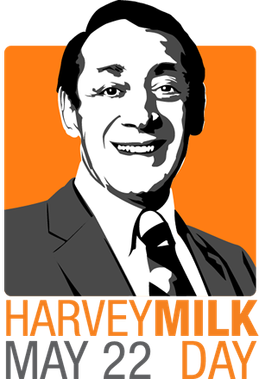
A little over a decade ago, the California state legislature passed, for the second time and with bipartisan support, legislation marking May 22 as Harvey Milk Day. In late 2009, Governor Schwartzenegger signed it into law. Some K-12 public schools have elected to observe it in various ways; a great many have not. Some, due to general unawareness or disinterest, some due to outright opposition to the notion, some due to uncertainty about how to talk about the contributions of LGBTQ+ people in their classroom.
For this last group, and for shelter-at-home-schooling parents interested in reviewing ways to note the day, we have some resources for you:
- Safe Schools Network: Harvey Milk Day Curricula for schools
- GSA Network: Harvey Milk Day resources page
- Teaching LGBTQ History: three lesson plans including Milk’s work and contributions
- Various books for K-3:
- Pride: The Story of Harvey Milk & the Rainbow Flag, by Rob Sanders & Steven Salerno
- For 3-7th grade:
- Who Was Harvey Milk? by Corinne Grinapol & Gregory Copeland
- The Harvey Milk Story, by Kari Krakow
Below is the Sanders & Salerno book in a beautiful read-aloud video by Miss Linda at Brightly Storytime, whose YouTube channel is chock-a-block with read-aloud book videos.
Harvey Milk made history in 1977 as the first openly gay elected official to win office (he wasn’t the first to run; that honor goes to José Sarria, in 1961). That election also held two other less-frequently noted firsts: the first Chinese American and the first African American woman elected to the San Francisco Board of Supervisors.
The day after his 1977 inauguration, Milk gave a speech in which he laid out a broad vision for San Francisco (and beyond):
“Let’s make no mistake about this: The American Dream starts with the neighborhoods. If we wish to rebuild our cities, we must first rebuild our neighborhoods. And to do that, we must understand that the quality of life is more important than the standard of living. To sit on the front steps–whether it’s a veranda in a small town or a concrete stoop in a big city–and to talk to our neighborhoods is infinitely more important than to huddle on the living-room lounger and watch a make-believe world in not-quite living color…
…too many of our cities have a complex, in fact, too many complexes. We don’t need another concrete jungle that dies the moment you turn off the lights in the evening. What we need is a neighborhood where people can walk to work, raise their kids, enjoy life.
That simple.”
While we are breathing life into those neighborhoods through protective masks right now, we are prizing them more than ever. It is so much easier to feel what community does for us when it is at arm’s length and further away. We at OFC continue to work to bridge that distance in any way we can: keep letting us know how we can help you better.
Meanwhile may we all continue to nurture the hope that we know will take us through to the other side of this time. However you pass the day today, we hope you find inspiration somewhere in it, and perhaps even leave a little inspiration for someone else.
