
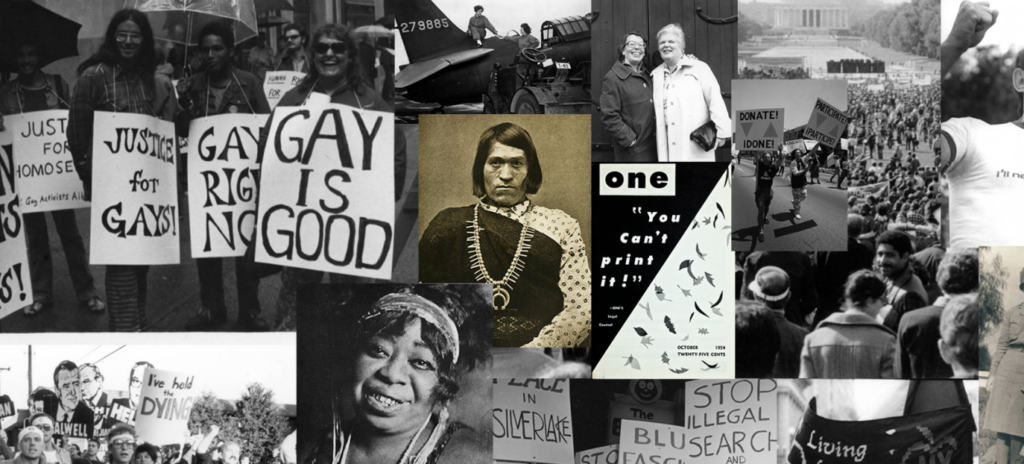
I didn’t know queer history growing up.

When LGBTQ+ History month was first celebrated in 1994 it was a very different world for us.

The number one rated show in the United States was Seinfeld; Ace of Base, All-4-One, and Boyz II Men were at the top of the charts for music; the box office hit at the theatres was The Lion King, followed at a very distant second by Forrest Gump. This was before Will & Grace and right after Pedro Zamora graced us with his presence as an openly gay participant in the Real World.

It was 21 years after the DSM removed homosexuality as a disorder and Matthew Shephard still had 4 more years to live. Bill Clinton’s administration had just passed the Don’t Ask, Don’t Tell policy in the military the previous December and gay sodomy would still be criminal in Texas for the next 9 years.

RuPaul just released Supermodel the previous year, and was growing into his own after being an extra in the B-52’s Love Shack video; it would still be three years before Ellen Degeneres would come out on her sitcom.

Rave and club culture was at its height, with everyone wearing fantastical costumes of every shape and color, and in New York, Michael Alig reigned supreme with his Club Kids.

Many in the community were still reeling in the aftermath of the AIDS crisis in the 80s, over the course of which we lost a whole generation of would-be elders to a disease that was notoriously, appallingly ignored by Ronald Reagan’s two-term administration. Safer sex campaigns were rampant and, for a time, AIDS was synonymous with “gay” and nothing else.

This was the world in which the first openly gay public school teacher in Missouri, Rodney Wilson, started Gay History month–eventually to be known as LGBTQ+ History Month.

I didn’t know queer history growing up.

What I did know was that gay people were made fun of and that gay people were the ones that got AIDS. I also knew that I was attracted to boys but didn’t want to admit it because of the previous two statements. Something else I thought I knew was that I hated history. The focus was on subjects that felt foreign, old, and irrelevant. We talked about dates and names but never really about desires, motivations, or the complexity of the human experience. Why should I care about the actions of dead people that didn’t look like me, act like me, or have anything in common with me?

It wasn’t until college, living on Capitol Hill in Seattle, that I was introduced to the concept of a community with a proud history, one that wasn’t broken down, tired, or defeated but one that had fought and survived through impossible odds to still bloom in the most hostile of atmospheres.

I remember going into the gay bookstore and seeing shelf upon shelf of books about people like me. There were our racy romance novels, our poetry and art, treatises and manifestos on queer theory, biting commentary and wit put to paper… but amidst all of those were books were tomes of a more ancestral timbre; our histories laying out a legacy for our present and future. I had always admired Dr. Martin Luther King, Jr. because it was the only part of history that made sense to me or that seemed to matter. But now, in this bookstore, I found the words of Eric Marcus and Leila Rupp teaching me about Harry Hay, the Mattachine Society, the story of Stonewall, and Harvey Milk. I didn’t dislike history–it’s just that until this point I didn’t know any that was written for me, and now I wanted more.

Suddenly, we mattered. I mattered.

We are now in the year 2021. The science fiction media during the early 1990s referred to the period we’re now in as the “not so distant future.” In California today, not so distant from the young man at that Seattle bookstore in the mid-90s, we are only beginning to understand what it means to teach the next generation of queers our history.

What a difference it would have made in my formative years to have had known that queerness was neither a phase personally or societally. The number of heartaches and the weight of guilt that could have been avoided if I had only known there were others like me, and that I was descended from a long line of beauty, strength, and rebellion.
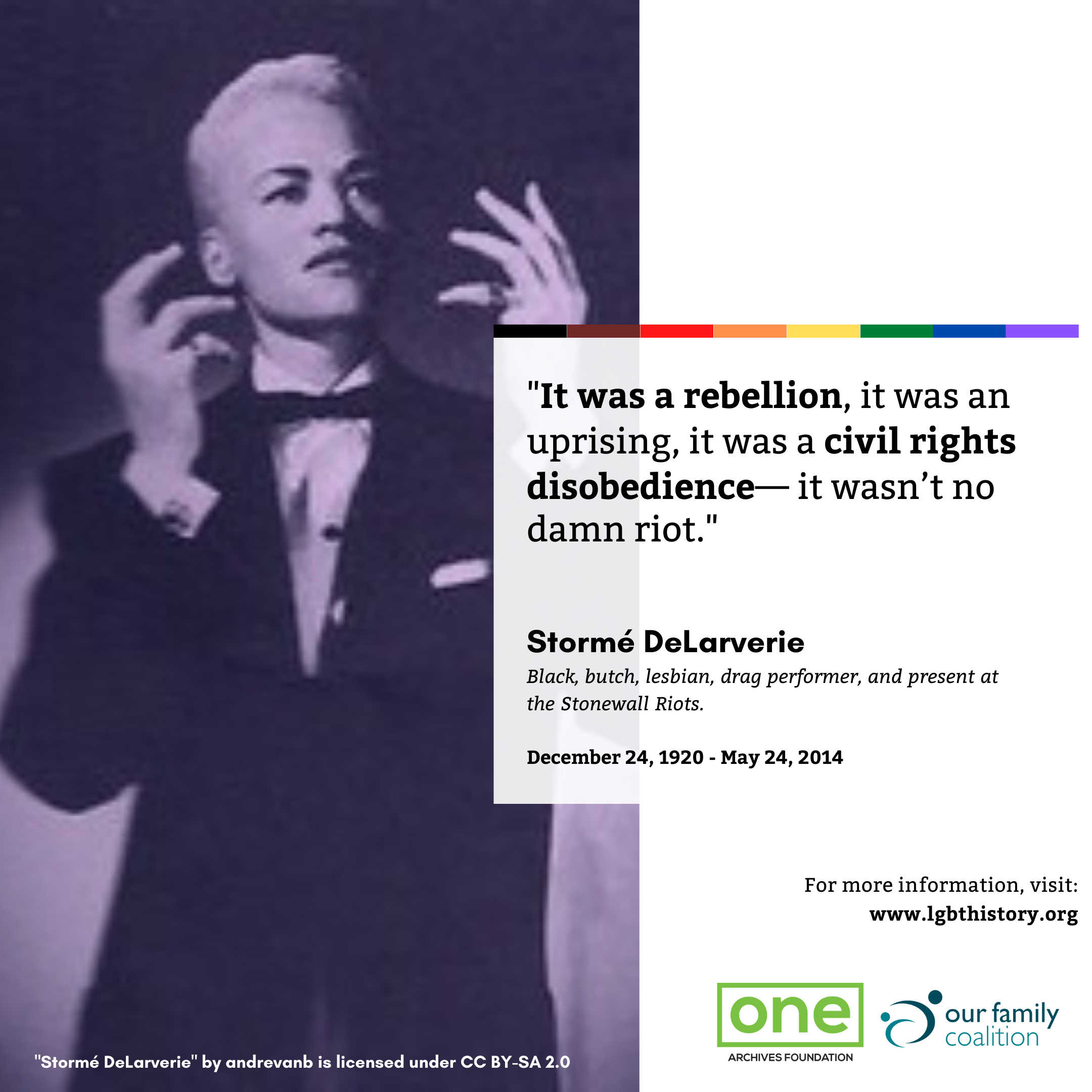
Stormé DeLarverieAs we push for a more honest and representative history, one that is more brown and queer and critical, we must also take the steps to celebrate in order to solidify that history in our nascent memories. Sadness will not be the sole note struck by our community. In this vein, for this LGBTQ+ History Month, Our Family Coalition is joining with ONE Archives Foundation to present 31 days of queer vibrancy, queer legacy, and queer hope.

We invite you to join us and learn about those that came before us, those that are still here, and those that we will become. Every day during the month of October we will be releasing an infographic featuring historic and iconic members of our community each linked to a resource or lesson plan where you can learn more about our queer family.

I was once asked why I worked so hard on queer history and why it was so important to me, and my feelings on it have not changed. I grew up afraid of becoming a joke or a casualty, but my kids will know that their uncle is more than a punchline or a punching bag. My kids, who are now in first and third grades, will not know a time when they didn’t learn about queer people in their classrooms.

Leave a Comment

read more

recent posts

UPDATED: The Skrmetti Decision is a Setback, Not the End

June 23, 2025

Your Rights in California in Response to Recent Executive Orders

March 20, 2025

SB 951: PAID LEAVE JUST GOT A RAISE

December 18, 2024

Thank you for joining us in celebrating and supporting LGBTQ families.

Every contribution, whether one-time or monthly, helps us honor the extraordinary LGBTQ families in our community. Our Family Coalition is the only organization in California dedicated to advancing equity and advocating on behalf of our families, and one of the few nationwide. By giving, you stand with us in pride and solidarity, ensuring that every family feels seen, valued, and celebrated. Your support has been crucial and with your help we can continue this legacy for generations.

Ask About Alternatives

You’re entitled to know if there are other options that might work for you. If a provider presents a single course of action, ask, “Are there other ways to approach this?” or “What other treatments might be possible?” or “Why are you recommending this treatment plan compared to alternative options?”

Pause and Reflect

If you’re unsure about a treatment recommendation, it’s okay to take a pause. Say something like, “I’d like to take some time to consider this before making a decision.” This gives you the space to process without feeling pressured. You can discuss a timeline with your provider that works for you. It is okay to want more time.

Right to Informed Consent

You have the right to understand all aspects of your care, including the risks, benefits, and alternatives. Never feel pressured into any procedure without clear information.

Confidentiality Protections

HIPAA laws safeguard your privacy and health information. Healthcare providers must keep all your personal health information confidential.

Anti-Discrimination Protections

Federal laws like Section 1557 of the Affordable Care Act prohibit discrimination in healthcare on the basis of race, color, national origin, sex (including gender identity and sexual orientation), age, or disability.

Advocate for Comprehensive Explanations

You have the right to fully understand any diagnosis, treatment, or procedure. Don’t hesitate to ask for explanations that make sense to you. For instance, say, “Can you walk me through how this treatment will work?” or “What are some possible side effects?” “What should I look out for?” 

Trust Your Own Knowledge


While healthcare providers bring expertise in medicine, you are the expert on your own body, experiences, and needs. If something doesn’t feel right, trust yourself and communicate your concerns. Phrases to lean on: “This is not normal for my body” “I have never experienced these symptoms before now” … 

Add Your Heading Text Here

Lorem ipsum dolor sit amet, consectetur adipiscing elit, sed do eiusmod tempor incididunt ut labore et dolore magna aliqua. Ut enim ad minim veniam, quis nostrud exercitation ullamco laboris nisi ut aliquip ex ea commodo consequat. Duis aute irure dolor in reprehenderit in voluptate velit esse cillum dolore eu fugiat nulla pariatur. Excepteur sint occaecat cupidatat non proident, sunt in culpa qui officia deserunt mollit anim id est laborum.

User Registration

In order to ask or answer questions, you must be logged in. Please create an account.

registration form

Subsribe to our newsletter

Sign in

In order to ask or answer questions, you must be logged in. 

User Registration

In order to ask or answer questions, you must be logged in. Please create an account.

registration form

Teacher Trainings and Professional Development

Each of OFC’s outstanding and practical workshops include:

  • Content learning, lesson plans and book lists​ that support teachers to have effective
    and developmentally supportive dialogue when teaching LGBTQ History
  • Reflective activities​ that allow participants to connect with their intersectional identities,
    gender stories and explore the dynamics of implicit bias to better challenge gender stereotypes
  • Current language and techniques​ to support families and teachers to talk more fluently
    and comfortably about all types of difference
  • Frameworks and models for effectively organizing coalitions​ interested in accountability
    and policy change in schools and organizations

Workshop topics:

  • LGBTQ History​: Teaching the New California History and Social Science Framework
  • LGBTQ-Focused Education Law and Policy​:​ Understanding Obligations and Protections
  • Implementing LGBTQ History:​ From Policy to Practice in your Region
  • Family Diversity:​ ​ The Early Childhood Classroom and Making All Families Visible
  • Gender Inclusion:​ ​ What is a Gender Spectrum and How Do I Reduce Gender Bias?
  • Transgender and Non-Binary Students​:​ How to Create Inclusive Spaces for All Genders
  • Anti-Bullying & Social Emotional Learning​:​ A Welcoming Schools Approach
  • Family and School Advocacy:​ Building Coalitions for Sustainable Change

For more information or to schedule a workshop, please contact the OFC Education Team: ​education@ourfamily.org

Sponsoship Benefits

Apply for a job

Job application
Enter email
Confirm email
Can be one or two files

Community Annoucements

Share your event or opportunity

Announcements will appear:

  • in a blog post on our blog (published and archived on our website, which is viewed by over 2,500 unique visitors each month)
  • highlighted in our monthly e-newsletter (distributed to over 7,500 email addresses)

Listings must be:

  • Designed for or of particular value to LGBTQ families and children and/or prospective LGBTQ parents
  • Located in the San Francisco Bay Area, if in person, or available online/ virtually, if outside Northern California

Deadline:

  • Content submitted by the third Tuesday of the month will appear in in the following month’s newsletter.

We love lifting up the good work that members of our community and other social change organizations are doing in the Bay Area and beyond! Let us know if you wish to share a community event or opportunity with our families.

Community Announcements
Title of event or opportunity, including host organization if applicable. For example: "LGBTQ Parents & Parents-to-Be Support Circle" or "Seeking Gay Dads for Study"
Location and address in one line, if applicable. For example: "Natural Resources, 1367 Valencia St., San Francisco"; "Link to the Study or Info Page”
Up to 300 characters (with spaces; about 50 words), describing the event or listing. For example: "This group is offered for LGBTQ-parents and parents-to-be who are awaiting adoption, the birth of their child(ren) through surrogacy, or who are pregnant. Share newborn care tips and learn simple mindfulness practices to increase ease during this time of so many unknowns and exciting transitions.”
Upload a logo or an image you'd like to accompany your listing. (optional)
Accepted file types: jpg, png, gif. Maximum file size: 256 Mb.

For further information

Enter email
Confirm email
Enter Email
Events can be distributed up to 3 times. For events far in advance, please specify which months you would like the event to run in our e-newsletter.

Share your story

We’re looking for stories by or about LGBTQ+ parents/caregivers or prospective parents, as well as the grandparents or adult children of LGBTQ+ headed families.

Generally, we hope your story will not only inform other families on LGBTQ+ family topics, but also let others know that they are not alone in the journey of advocating for our families.

Whether you feel like you’ve arrived, or your story is not yet complete, know that we can keep one another company all along the way. And it always helps to feel a little less alone.

  • How is your family structured?
  • What is your family formation story?
  • Have you faced challenges in forming your family or parenting because of your identity?
  • How were you able to navigate these challenges?
  • What has been the impact on you/your spouse/children?
  • What systems/people helped guide you?
  • What advice would you have for other LGBTQ-headed families – or perhaps just your younger self?
  • How have you or your family dealt with challenges at schools, medical providers, or elsewhere?
  • Were there times when you expected resistance and instead were welcomed?
  • Do you have opinions you’d like to share about current events, or perhaps movies, TV shows, music, or more?
  • Do you have a story about how Our Family Coalition has had an impact on your or your family that you’d like to share?
Share your story

Upload your story content here - up to 1,000 characters

By checking this box, I consent to the content I've uploaded here, both written and photographic, to be published on Our Family Coalition's blog.

I understand that the content will be freely available on the internet and may be seen by the general public. I further understand that Our Family Coalition cannot be held liable for the theft and re-publication of this content.

I further understand that I will be given an opportunity to review (or revoke) the piece before it is published.

This consent will be treated confidentially.

Scroll to Top