
 As a person of color that went through the ‘American’ K-12 education system, I felt that the social sciences we were taught did not accurately reflect the history of communities of color or any other marginalized groups–times minorities were mentioned were when we learned about exploitation, colonization, racism, etc. I never understood why inner city schools, such as the one I attended, taught history that was irrelevant to the demographic of the school—most being sons and daughters of low-income immigrant parents. Narratives of significant people and/or historical events were briefly told, if told at all. And of course, they were told through the colonizer’s point of view rather than by the colonized.
Once I got to college, I learned that there were classes that offered an alternative point-of-view to the history I had been taught. The content from these classes differed from what I had already learned in the sense that it presented me with relatable material and material that was more inclusive to the diversity that exists within the United States. Classes I took ranged from ethnic studies to gender and sexuality studies. I found it a bit problematic that I had to go out of my way to seek such courses rather than being presented with the information earlier in my education career; however, I am grateful to have had the privilege to access these resources that helped develop my consciousness and form my identity.
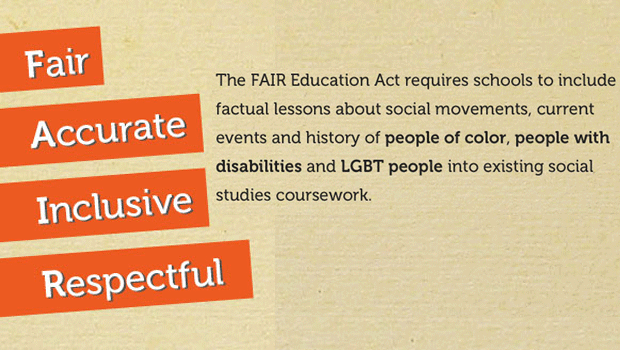
With just four years of getting out of the California’s K-12 public school system, I am excited to know that there are positive changes to the curriculums of public schools coming down the pipeline. In July 2011, Governor Jerry Brown signed into law Senate Bill 48—the Fair, Accurate, Inclusive, and Respectful (FAIR) Education Act. It calls for the inclusion of people with disabilities and LGBTQ Americans’ important historical contributions to the economic, political, and social development of California.
Now in 2014, I was disappointed to see that the Instructional Quality Commission really did not fulfill the intent of the FAIR Act since their recommendations to the new social science framework are minimum to none.
In an attempt to align the History – Social Science Framework with the requirements of SB 48, Our Family Coalition (OFC) partnered up with Gay-Straight Alliance Network and the Committee on Lesbian, Gay, Bisexual, and Transgender History (CLBTH) to recommend revisions to the existing framework and submit those to the State Board of Education’s Instructional Quality Commission (IQC). The revised Framework calls for a transformational approach in which students understand concepts and issues from the perspectives of diverse groups of people.
Here are some recommended revisions by grade and theme that were brought up in the Making the Framework FAIR report that I support:
• Grade 2: LGBT families in the context of understanding family diversity as a contemporary and historical reality
• Grade 4: Central roles played by gender and sexuality in California’s history as a site of rich, contested, and changing diversity
• Grade 5: Variation over time, region, and culture in colonial American practices and laws with regard to gender and sexuality
• Grade 8: Fundamental transformations in gender and sexuality in conjunction with nineteenth-century urbanization and industrialization
• Grade 11: The evolution of modern LGBT communities and identities; twentieth-century persecution of sexual and gender minorities and the growth of the LGBT civil rights movement
The inclusion of the LGBT community in California’s K-12 public school curriculum is long overdue. The LGBT community represents a significant part of the history and social fabric of California, yet their presence in textbooks is nonexistent. I believe the absence of such communities in the early learning stages of youth can affect their perception of the LGBT community. It can be something that they do not see as ‘normal’ thus they may develop a sense of dominancy and begin harassing the community.
As we know, individual students feel safer at school when diversity issues are included in the curriculum; this is true for LGBT students and for their straight peers. Schools without inclusive curriculums see more cases of reported bullying. Maybe if I would have seen myself accurately represented in textbooks, I wouldn’t have to wait until college to truly understand my history and that of my peers.
 Now let’s hope that the inclusion of LGBT communities in history and social science classes actually helps students navigate the economic, political, and social development of California rather than just present students with a few token historical figures. It is time to call for a truly representative curriculum that does not exclude to contributions of great portions of our communities, including the LGBT community.
FOR MORE INFORMATION ON THE FAIR ACT IMPLEMENTATION AND PUBLIC COMMENTS THAT YOU CAN SUBMIT TO THE DEPARTMENT OF EDUCATION, PLEASE CLICK HERE.
By Isidro Manuel Lopez, communications/media intern at Our Family Coalition and broadcast & electronic communication arts student at San Francisco State University.
